The Mangalore Railway Region Transfer to Mysore/SWR
A complete look at the majorily controversial decision and its repercussions
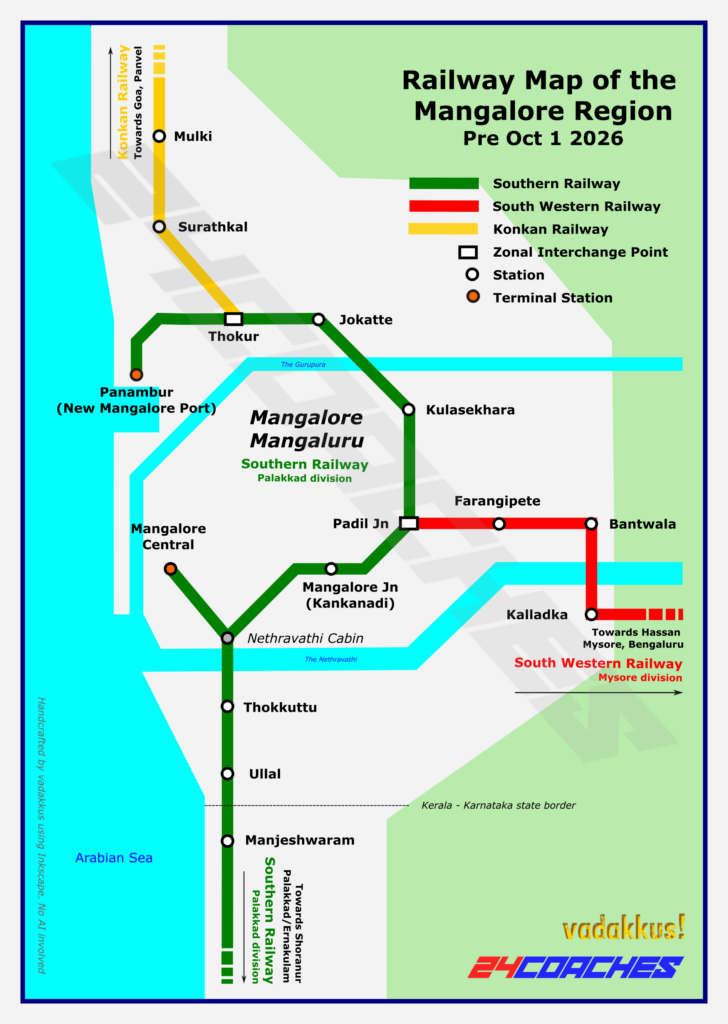
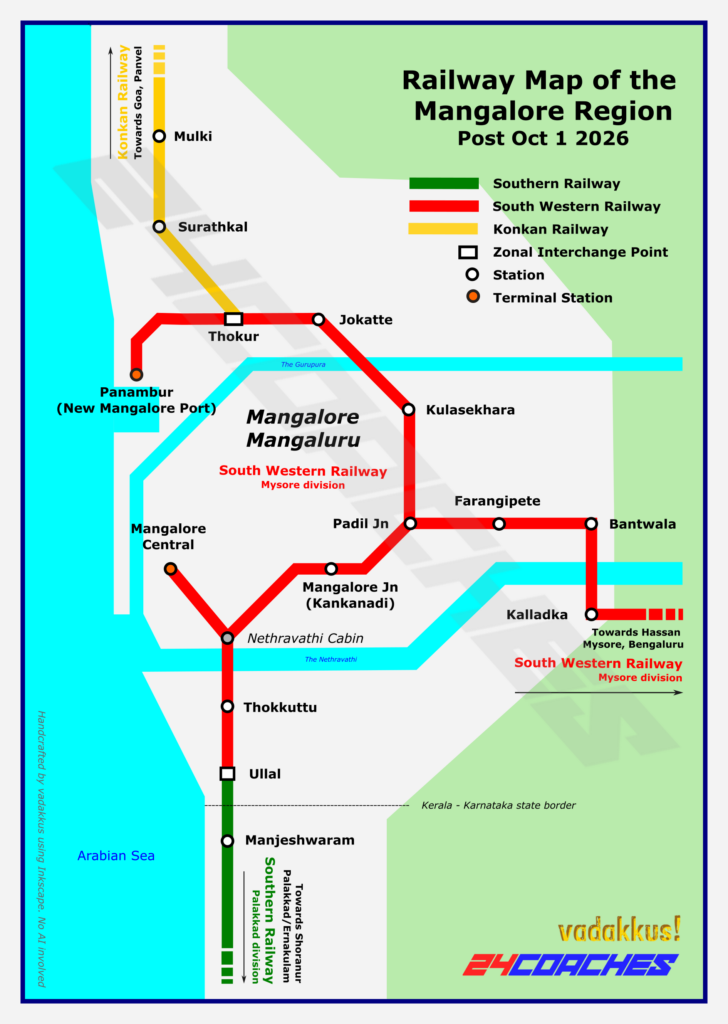
All hell has broken loose with the Railway Board’s announcement that the Mangalore (Mangaluru) region currently under the Palakkad division of the Southern Railway (SR) would be transferred to the Mysore division of the South Western Railway effective October 1st, 2026. The transfer will affect all railway lines, assets and equipment currently under the jurisdiction of Southern Railway north of the station of Ullal (including) on the border of Karnakata with Keralam. This includes two major terminal stations and associated coaching yards and depots at Mangalore Central (MAQ) and Mangalore Junction (MAJN) stations, the New Mangalore Port’s freight loading facilities at Panambur, major sidings at Bundar and Thokur HPCL smaller stations such as Tokkottu, Padil, Kulasekhara and Jokatte, all of which lie in Karnataka, and all associated administrative and operational infrastructure.
The Mangaluru region is a railway hotspot and among the most important major railway operations bases on the western coast. Three major railway lines from three distinctive regions meet at Mangalore. The railway lines and stations themselves are part of the Southern Railway as a continuation of the historic Chennai-Mangalore line from Palakkad The Konkan Railway line from Mumbai and Goa in the north joins this line at Thokur, which is currently the northernmost railway station of the Southern Railway. The railway line from Hassan and Bangalore under the jurisdiction of the South Western Railway joins the SR line at Padil on the eastern outskirts of the city. What has now changed is the that this SWR line will now continue into Mangalore to take over all the lines currently managed by SR, up until the Ullal station (including) of Southern Railway in the south at the Keralam-Karnataka border. Manjeshwaram in Keralam will now be the northern-most railway station of the Southern Railway. The SR-SWR interchange station at Padil will cease to exist and will shift to Ullal. So this will effectively ensure that all railway lines and stations in the region within Karnataka will now be under the control of SWR.
This is how the railway map of Mangalore looks before and after the reorganisation
The division of the Palakkad division 🙂 has generated a lot of noise for what looks like just an operational and administrative realignment. The Chief Minister of Keralam himself has gotten involved and had written to the Railway Minister to reconsider this decision. Various politicians from Karnataka have stood steadfast welcoming the move and the Minister of State for Railways who is also from Karnataka and has thrown his weight behind the decision. This is not a surprise since anything around the Indian Railways ends up highly politically charged, especially when it comes to jurisdictions. Mangalore lies only a few kilometers from the Karnataka-Keralam state border which the railway line predates by half a century. The region shares a lot of commonalities and the northern districts of Keralam have a great deal of dependency on Mangalore. Also, a good deal of railway staff working in Mangalore are from Keralam. And above all, the revenues from freight loading from the New Mangalore Port is not something that the current administration at Southern Railway would want to let go of.
Why is this controversial?
Mangalore, part of Karnataka’s Dakshina Kannada district is the second largest city in Karnataka as per economic value after Bangalore itself, thanks to it being a massive industrial center with its port, petrochemical refineries and allied functions and defense establishments along with its renowned education and medical centers. And this is where the question of the revenues come in. The New Mangalore Port generates around Rs.600 crores in freight loading revenues every year. This revenue is accounted to the Indian Railways and claimed by the Southern Railway. Since the port comes under the administrative division of Palakkad it was often claimed that the division was giving nothing in return while pocketing the revenue.
The outrage by Keralam was mainly motivated by the fear for the survival of the Palakkad division. The argument was that the loss of Palakkad division’s only terminal at Mangalore would leave the division with no trains to operate. And Mangalore happens to be the northern terminal point for trains running the length of Kerala. These would now move under the control of South Western Railway who will decide the timetables, stoppages and origin/destinations of trains through Kerala and all of Malabar would now be controlled by Mysore (not the first time this has happened). Palakkad division would also be unable to propose new train services in Kerala and would be dependent on South Western Railway or other divisions of Southern Railway. More importantly, the loss of New Mangalore Port would mean that the gains from freight loading would shift to South Western Railway, making the Palakkad division financially unviable as it will lose around 80% of its revenue generating capacity. This would lead to sharp decline in revenue allocation as well. All this put together would make the continuing existence of the Palakkad division questionable.
A division with no terminal, no trains and no freight loading makes no sense to continue exist as a division. It is expected that the Palakkad division will soon be proposed to be merged with the Trivandrum division. Kerala will hence become a state with only a single railway division (while neighbouring Karnataka and Tamil Nadu will have four each). This would further reduce funds allocations and the scope for development projects for the state, making things even worse than it is now.
This will be quite a fall for the state that once harboured aspirations for its own railway zone.
The grievances of those who were advocating for separating Mangalore division from Palakkad division and adding it to Mysore division were many. As gathered from numerous online comments through social media they are:
- SR/PGT prioritised running trains to Keralam over trains to other parts of Karnataka.
- Platform allocation precedence at Mangalore Central station was given to Keralam-bound trains.
- No dedicated trains are started from Mangalore to state-capital Bangalore despite the high demand.
- Any existing trains from Bangalore were extended to Keralam and Konkan reducing seats from Mangalore.
- The Mangalore Jn and Mangalore Central stations were never developed with modern and proper facilities.
- All the staff at the Mangalore stations including vendors are all non-locals who can’t speak the local languages.
There has been a decades-long vociferous demand by the politicians and many people of the Canara/Karavalli region (as the region from Udupi to Mangalore is called) for the railway lines in the Mangalore region to be separated from the administration of Palakkad division and Southern Railway and made a part of the South Western Railway. This demand is in fact older than the division itself.
A bit of history of the Railways in the Mangalore region
The railways reached Mangalore on the 3rd of July, 1907 as the culmination of over half a century worth of efforts by various British agencies to connect the eastern and western coasts of Peninsular south India. The idea was to enable faster trans-shipment of goods, mail and troops between the eastern and western coasts of India, thereby reducing transit times between Calcutta and British Indo-China and Europe.
The interesting fact is that Mangalore wasn’t even a part of this plan at first. The Madras Railway Company who built the line first envisaged the port on the Western coast to be at Beypore near Calicut and built the line from Madras to terminate there. When the port didn’t really take off they started exploring other places under British jurisdiction. Mangalore with its already famous “Bundar” seemed to be a good choice worth even bridging several rivers on the way including the massive Netravathi, which remains a remarkable feat of engineering of the day. The Mangalore station was built at Hampankatta for its proximity to the Bundar. The railway line would end in a series of sidings close to the shore so goods trains could come right up to the warehouses and wharfs. The siding still exists today.
From Mangalore, the line didn’t really have to go anywhere for a long time. The British and the South Indian Railway didn’t see it worth the economic or political trouble to extend the line past Mangalore. The east had massive mountains outside British jurisdiction (Mysore state) and there was little economic activity or population towards the north and also Portuguese Goa lay in the way. Mangalore hence remained the lonely rail head on the south western coast for 70 years.
After independence, the railway territories controlled by the South Indian Railway were incorporated into the Southern Railway zone that covered all four south Indian states. Mangalore was placed under the massive Palakkad division as its northern-most station and terminus of the line from Jolarpettai. The New Mangalore Port at Panambur in 1974 would extend the line from the Netravathi bridge to the Port via Kankanady, Padil, Kulashekara and Thokur. But is was in 1979, 72 years after the first railway line cross the Netravathi that another one would join it when the Meter Gauge line from across the Ghats at Hassan would reach Mangalore, finally connecting it with the rest of Karnataka. With the commissioning of the Konkan Railway line from Thokur to Udupi in 1993, the railway network in the Mangalore region was complete. Both the extension to the new Panambur port and the Hassan – Sakleshpur – Mangalore line were built by the Southern Railway.
In 1986 the Mysore division was split to form the Bangalore division of the Southern Railway, and in the year 2000 the Southern Railway and the South Central Railway were carved up to create the South Western Railway zone (SWR). A product of what is popularily known as the Hajipurization of the Indian Railways, SWR was for all intents and purposes, intended to be a railway zone for the state of Karnataka. Mangalore though remained a part of Southern Railway. It was then expected to be included in SWR after once the gauge conversion of the Hassan – Mangalore line to BG was completed. However what happened instead was that the Palakkad division was carved up to create the Salem division in 2006, the year the gauge conversion was completed. Southern Railway, unwilling to let go of the revenue from the New Mangalore Port hung on for another two decades until now when political action finally made it possible.
However though a significant political gain has been achieved, nothing might change at all in terms of addressing the grievances of the region and the activists in terms of their demands in the short or medium term because the issues the Mangalore region faces is not administrative but infrastructural and geographic. And they have also the infamous Indian Railways bureaucracy to deal with.
Why things might remain the same
Indian Railways’ policies often are aligned towards prioritising and optimising freight operations over passenger because that is where the money comes from. Passenger just gets the better PR and airtime. For instance Indian Railways’ single largest investment of the past decade was not towards Vande Bharat or the Bullet Train but towards the DFC. For many decades infrastructure around Mangalore was built up to optimise freight loading and movement since a good chunk of Southern Railway’s income came from there. And it is unlikely that SWR would suddenly take a different approach. There needs to be quite a bit of passenger-centric coaching infra that has to be built up around Mangalore for any serious change to materialise. Let us examine each of the grievances that are being raised by the local population and how these would take time to change.
Mangalore does score on the train running and freight handling infrastructure. Mangalore Central has six platforms which is more than even the divisional HQ at Palakkad Jn and only second in the division after Shoranur Jn. All railway lines in the Mangalore region are double tracked (and electrified) except the 500-meter bypass line connecting Mangalore Jn to Mangalore Central. The Mangalore Jn to Padil line is even triple tracked. There is a freight wagon maintenance center at MAJN and stabling lines at the Bundar and a major siding for HPCL at Thokur, and of course it has the major freight complex at Panambur. What the Mangalore region lacks though is the passenger train handling infra. Mangalore coaching depot has only 3 pit lines at MAQ handling around 20 trains which is definitely not enough. It needs up to 6 pit lines and around 8 stabling lines capable of handling at least 500 coaches.Mangalore Central is severely space-starved due its central location and cannot be expanded anymore but Mangalore Junction can be be expanded to five platforms from the existing three. A MEMU shed to handle MEMU services to the surrounding regions would help too.
Coming to train operations there could be a few justifications on their stand. Many major trains out of Mangalore towards Kerala (the Chennai trains, Malabar, Parasuram, CBE express, etc.) were started when no other line out of Mangalore existed. Some of them date back to British times even, such as the 12601/12602 Mangalore – Chennai Mail which is one of the oldest trains in the country, running for more than 150 years! The reason why trains from Bangalore are extended outwards is precisely due to the reason that Mangalore lacks parking space. A train from Bangalore will have a lie-over at Mangalore for around 10 hours and there is simply no space to park them there for that long. The same goes for platform availability at Central. However it is to be noted that the Mangalore – Vijayapura daily express did managed to get a platform at Mangalore Central. If Southern Railway had started a Mangalore – Bangalore – Chennai express with Primary Maintenance at Mangalore it maybe would’ve solved this problem.
Staffing though is a complicated issue. Indian Railways is a central government organisation staffed by centrally-recruited, faceless officers from all over the country who usually have no local or regional loyalties and work as per directives from the Railway Board or zonal headquarters who in turn won’t take decisions favourable locally unless they are pressurised by local politicians with influence in Delhi. Shifting to SWR wouldn’t mean immediate realignment of staffing policies. Existing staff in Mangalore working with SR would be given a choice to continue on to SWR or to be transferred to SR, and the posts becoming vacant would have to be filled with fresh hiring, all which would take years. In the short to medium term all current staff positions would remain as they are.
Now, coming to the main bone of contention. The real reason that there are no trains out of Mangalore to any region other than Kerala is simply because there is no infrastructure to support it. The Konkan Railway line is single track for all its 738 km and is currently super-saturated. There have been no new daily trains launched on the Konkan Railway from Mangalore (except the Vande Bharats) for 12 years now. This train was incidentally launched by Palakkad division and was from Mangalore to Madgaon. However, the 22635/6 SF Intercity was famously the least occupied train in the zone was soon downgraded to a MEMU which still runs today. It wouldn’t be possible to start any trains northwards from Mangalore without doubling the Konkan Railway line.
The case of trains eastwards towards Hassan, Mysore, Bangalore and the rest of Karnataka is even more dire. There are only four pairs of daily trains that connect Mangalore with Bangalore, and this has been a massive bone of contention for a long time. However geography is mainly to blame for this though. The Mangalore – Sakleshpur – Hassan railway connecting Mangalore with the rest of “mainland” Karnataka has to cross the Western Ghat mountains that reach more than 1000 meter elevation in Karnataka. The Western Ghats over Karnataka (called “Malnad” or “Malenadu”) do not have a prominent low mountain pass like the Palakkad Gap and the railway line has to literally go over the mountain. For 52 km between Subramanya Road and Sakleshpur the line twists, turns, climbs and descends along the sides of various mountains through the jungles of Malenadu reaching altitudes of up to 900 meters featuring one of the steepest gradients on Indian Railways at 1:55. The single line operation is tightly controlled requiring continuous speed restrictions, banker locomotives, extensive brake testing, frequent maintenance to the tracks and so on. The infrastructure will always be fragile and at a disadvantage and cannot be put under more than a certain amount of stress and train operation across the Ghats will hence always be extremely limited. However, that is not all, there is a bureaucratic angle to this as well.
The HMRDC Angle
Though the line comes under the jurisdiction of the SWR, the Hassan-Sakleshpur-Mangalore railway line is administered and operated by a different entity outside of complete railway control. The Hassan Mangalore Rail Development Company (HMRDC) is a PSU joint venture (JV) undertaking that was created by the Indian Railways and the government of Karnataka with the explicit goal of undertaking the gauge conversion of the meter gauge line to broad gauge and to operate it as a concessionaire until 2036. Hence HDMRC still controls the working of the line and deems ownership of all revenue accrued from it. Given the fragile nature of the line, the cost involved in maintaining a railway line running over the mountains and to pay back construction costs, HDMRC have put up a series of strict restrictions on running trains on the line.
- A 30 kph PSR (Permanent Speed Restriction) on the 55 km of ghat stretch from Sakleshpur to Subramanya Road. This means trains will take about 2.5 hours to cover 55 km. Even the Vande Bharat is not excempted from this.
- Only 24 trains are allowed to pass per day including all passenger and goods trains (revised in 2020).
And among these freight train operations are given precedence for economic reasons and to keep the line viable. There are currently only 10 pairs of trains a day on this route, five up and five down. Four pairs among these trains are daily, two pairs are tri-weekly and one is a weekly special service. The Vande Bharat between Bangalore and Mangalore would be only the 6th train on the route. After this it is very difficult to see HDMRC allowing any more passenger trains on the route lest should they eat into the freight capacity.
All this means even if the Mysore division were wanting to start more passenger trains from Mangalore towards Bangalore, the HMRDC would not allow it, and even if they did, the Ghats would not. And even after all administrative changes, the Southern Railway line via Palakkad will still be preferred for freight movement simply because as a fully electrified, double tracked line across coastal plains it can run more, longer and heavier freight trains faster and cheaper compared to the Sakleshpur – Hassan line.
A new railway line between Mangalore and Bangalore
It is simply not possible to scale up train traffic between Mangalore and Bangalore with the existing infrastructure. Doubling the line would be near impossible given the terrain and geography and all the stringent environmental restrictions that are now in place. It is very clear that this creaking old railway line built on an alignment from the 1960s is unable to match the requirements of a growing economy and needs to be replaced.
The only way to enhance railway connectivity between Mangalore and its state capital is to build a brand new, fully electrified double-track railway line between Mangalore and Hassan designed for 160 kph speeds. In fact this should’ve been done when the old meter gauge line was converted to broad gauge instead of just following the old alignment to save costs. This is one of the countless railway line in India where they did the same mistake and converted existing snaking, looping MG lines to BG on the same alignment just because they had to do it instead of building straight railway lines with foresight for the future.
There’s also DPR being prepared for a new greenfield expressway between Mangalore and Bangalore via Kunigal and Hassan that is expected to cut travel times between the cities to just 3 hours! The new railway line needs to be developed as a co-project with the highway. If not, the railway line will just become pointless and redundant.
The question of “Neglect by Palakkad Division”
It might be controversial when I say this but I don’t believe there is some grand conspiracy hatched out of Palakkad to neglect the Mangalore division. This is because a railway division is an administrative unit of the larger zone built to run day-to-day activities. These include train operations and management including timetabling and section controlling, commercial functions, personnel management, managing contracts, tenders and various railway assets. It has very limited decision making authority on its own outside these. For example, they do not have any authority to sanction large-scale development programs or run new trains or allocate rakes. All development programs are always sanctioned at the ministerial or railway board level. Indian states are not entitled to any share of any railway revenues, freight or passenger, which are booked at the zonal level and accrued to the Indian Railways alone and have no say about how any railway operations are conducted unless it is a JV with the state government like HMRDC or KRDCL (K-Rail).
The accusation that Palakkad division neglected Mangalore is hilarious. They didn’t neglect Mangalore in any special way but they just neglected it the same way they did the rest of the division. It is not as if the rest of the division is wallowing in some kind of luxury but the conditions are worse.
In fact, Mangalore might have the best infrastructure in all of Palakkad division. Palakkad has no coaching terminal outside of Mangalore and hence has also the ignominious glory of being the only divisional HQ in all the country that does not have its own originating express train (After the split it will not have any express train of its own at all). Only recently did they start building pit lines at Palakkad. Even Kannur with five terminating trains does not have a pit line.
Station facilities and platforms: The less said, the better. Even in high-grossing stations like Kozhikode and Kannur don’t have enough facilities or amenities. Stations buildings and platforms are decades old with no modernisation with cement floors and peeling shellcem paint. Some stations were lucky enough to be developed through the Amrit Bharat scheme but that had nothing to do with the division.
Train operations in the Palakkad district is even more pathetic. Despite being fully electrified there is only one MEMU service in all of Malabar. Yes, just the one. I am not kidding. There is a gap of 6 hours during the day when there is no train from Kannur to Ernakulam and regular 1.5 to 2 hour gaps in the middle of the day when no train at all runs. There are only two daily trains between 9 pm and 5 am going southwards from Kannur or Kozhikode.
Coaching: The rakes and coaches of nearly all of Palakkad’s trains are a couple of decades old and are rotting from the inside out. Parasuram, Ernad, Intercity, Malabar etc would’ve been declared a public health hazard in any other country. Parasuram Express which runs the length of Kerala during the day time is the most heavily patronised train in the country where people travel packed in its stinking coaches not just like sardines in a can but smelling likewise as well.
See, most people do not realise that after it was split to form the Salem divison, the entire reason for the existence of Palakkad division was to service the Mangalore Port. Southern Railway probably saw no reason or incentive to improve conditions in the division as long as the revenue from the Port was rolling in. The passengers were left to suffer in all regions and especially when it is well-known how step-motherly Southern Railway treats the two Kerala divisions.
A good move
The noise from the government and a section of others in Keralam notwithstanding, bringing the Mangalore region under the administration of the Karnataka-based South Western Railway might be a good move. Decentralisation is always better with power resting where it is being applied. However, given how the Indian Railways bureaucracy works, it would be unwise to expect any major changes to how the railways in Mangalore in the short to even medium term works other than some minor changes here and there. It would require long-term planned ramping up of coaching infrastructure in Mangalore, doubling of the Konkan Railway and solving the issue of the Sakleshpur Ghat railway line for any substantial changes to passenger traffic to be visible in the region. As of now SWR would be happy to add the Mangalore Port revenues to its kitty. For Keralam however, this would be a chance to get their act together and create some real infrastructure upgrades in what is left of Palakkad division including a new terminal somewhere in Kasargod district. In fact, taking this as an impetus, Keralam could also go demanding better localisation of its railway administration and should start working long-term towards developing its railway infrastructure to get it to a level where it can demand its own railway zone and the government cannot ignore it.
Cover image generated using Leonardo AI. No AI was used in any capacity in creating the text copy of this post.